• Skip to main content
  • Skip to primary sidebar
  • Skip to footer

Sino Machine Industries

  • Home
  • About Us
  • Industries Served
    • SMI Products Overview
      • SMI Special Steel Products 01
      • SMI Special Steel Products 02
      • SMI Metal Recycling
      • NDT (Non Destructive Testing) service
  • Capabilities
    • Aluminum Industry
      • Aluminum Dross Press
      • Aluminum Dross Cooling Pan
      • Alloy Steel Sow Mold
      • Aluminum Dross Skim Blades and Skim Tools
      • Aluminum Furnace Skimming Tool or Skim blades used for Stirring and Mixing
      • Dross Press & Dross Processing
      • Application of Intelligent Ladle Slag Scraper (Skimming Tools) in steel mills and aluminum mills
      • Transmission Parts
      • The correct combination of the press head and the dross pan
      • 7-9kgs Small Standard Ingot Molds | Moldes de lingotes estándar pequeños de 7-9kgs
      • Comparison between Sow Molds and Ingot Molds
      • Aluminum Dross Transport Equipment
      • Aluminum Dross Recycling Systems
      • Aluminum, Magnesium, Brass, Bronze, Lead, Zinc Ingot Molds
      • Anode steel claw (Electrolytic claw) | Garra de acero del ánodo (garra electrolítica)
      • Anode Steel Yoke
  • eNews
  • Contact Us
You are here: Home / Archives for Coffy

Coffy

January 23, 2026 By Coffy Leave a Comment

Casting vs Forging vs Machining: Choosing by Wear Mechanism

Quick summary: Most mechanical components are made by casting, forging or machining, often in combination, with welding used for structures and repair. The right route depends on the duty the part sees and how it fails. A supplier who understands material behaviour, process capability and wear mechanisms can help a customer choose route, material and design before the drawing is finished.

Three Main Routes, Plus Welding

The same component geometry can be produced by different routes, and each route carries its own material logic:

  • Casting: suited to complex shapes and heavy sections. High-manganese steel is used for mining wear parts where impact and abrasion dominate; heat-resistant cast iron and cast steel are used where thermal cycling and molten metal contact drive failure.
  • Forging: suited to parts requiring directional strength and toughness, such as tillage wear components and load-bearing forgings, where grain flow and impact resistance matter.
  • Machining: suited to dimensional accuracy, fit and material consistency, and often the finishing route after casting or forging.
  • Welding: used for structural assemblies, and for repair or hardfacing where surface wear resistance is needed without replacing the base component.

The choice is not a catalogue decision. It follows the duty the part sees, the failure mode it must resist and the material’s behaviour under that duty.

Why Wear Parts Fail, by Industry

Every industry has its critical wear parts, and the failure mechanism differs by industry:

  • Mining crushing and conveying: abrasive wear, impact and gouging; hardness and toughness must be balanced against feed size and throughput.
  • Aluminum melting and recycling: thermal shock, molten aluminum attack and repeated thermal cycling; base material and structural design govern service life.
  • Tillage and ground-engaging equipment: soil abrasion and impact; forged wear blanks and hardfacing-compatible designs extend life.
  • Onshore oilfield transmission: fatigue, load and legacy-fit constraints; material and heat treatment determine reliability.

A supplier who knows these failure modes can discuss material and process route with the customer, rather than simply quoting a part number. For examples, see our guides on crusher wear parts and ingot mold failure modes.

Verifying the Base Material

Test bars, cut from the part or from a companion coupon of the same heat and process, confirm that base chemistry and heat treatment meet the design intent. Hardfacing and coatings improve surface wear resistance but do not represent the core material, so for cast and machined parts where material grade governs performance, verification is carried out on the base material. Material certification and NDT inspection to relevant industrial standards are available where the application requires it.

One Example: the Dross Press

A dross press is judged on working capability and cycle efficiency, not on one component’s material grade. Material and structure work together over repeated thermal cycles: the cooling head is made from SMI’s anti-thermal-shock castable, the dross pans from alloy steel, and structural design (wall thickness transitions, ribbing, discharge geometry) is part of the result. See our aluminum dross press systems.

The same logic applies across the six areas we serve: aluminum melting, mining crushing and underground conveying, onshore oilfield transmission, truck/trailer and forklift components, general custom mechanical components, and tillage wear components.

FAQ

Can you help choose between casting, forging and machining for a component?

Yes. Send us the duty, failure mode, section size and dimensional requirements, and we will recommend a route and material accordingly.

Do you verify base material for cast and machined components?

Where required, base material is verified through test bars from the same heat and process, so the result represents the delivered material rather than surface condition.

Can material certification and NDT be provided?

Yes, where the application requires it and subject to your technical requirements. See our NDT service.

Working on a component where material and process route matter? Contact SinoMachine to discuss your application, or review our aluminum dross press solutions.

Filed Under: Technical Guides

October 28, 2025 By Coffy Leave a Comment

Dross Pan Cover: Oxygen Barrier, Not Insulation

Dross Pan Cover: Why It Is an Oxygen Barrier, Not an Insulation Blanket

Ask anyone what a lid does to a hot container and the answer is immediate: it traps heat and slows cooling. That everyday thermal logic fails completely on freshly skimmed aluminium dross — but not for the reason usually given. A dross pan cover does not speed up cooling by “trapping heat in and starving the fire.” It works because hot dross is not a passive heat mass at all — it is a self-heating one, and the cover stops the heat source rather than improving heat extraction.

Key figures
  • Hot dross is skimmed at roughly 680–780 °C — well above the point where metallic aluminium self-heats in air
  • Open pan, uncontrolled: cooling to a safe temperature can take up to 12 hours. Covered with inert gas: well under 4 hours
  • 60–85% of the cooling duty is done by the pan body acting as a heat sink — not by the cover
  • Below about 400 °C, oxidation and aluminothermic reaction stop and metal is no longer lost

1Why the Intuition Breaks Down

Hot water in a covered pot cools more slowly. Nothing about that changes here — a cover does suppress surface convection, and in a purely passive system it would slow cooling down. What breaks the analogy is that hot dross is not passive.

Freshly skimmed white dross leaves the melting or holding furnace at roughly 680–780 °C — a temperature operators read by colour, deep red when too cold and bright yellow-white when too hot. It is a heterogeneous mix of free metallic aluminium droplets, alumina, aluminium nitride and minor salt flux residues. At that temperature, metallic aluminium exposed to air undergoes a self-sustaining exothermic oxidation, widely called thermiting or dross burning:

4Al + 3O2 → 2Al2O3 + heat

This is the point most explanations miss. In an open pan, the dross is not simply losing heat to its surroundings — it is continuously generating new heat for as long as oxygen keeps arriving. Radiation and natural convection are partly offset by that internal heat source. The smoke and fume above an open pan are fine alumina particulates from aluminium vapour and surface combustion, and they are visible evidence of metal being destroyed in real time.

The reaction self-feeds until one of two things happens: the dross temperature falls below roughly 400 °C, at which point oxidation and the aluminothermic phenomenon stop and metal is no longer lost — or the oxygen supply is cut off. A cover addresses the second route.

2What a Cover Actually Does — and What It Does Not

Here is where a lot of casthouse folklore goes wrong, and it is worth being precise because the difference has real commercial consequences.

A cover dropped onto a pan is not a sealed vessel. Air continues to infiltrate through the gap between cover and pan rim, through the aluminium drain holes in the base of a press dross pan (or the ventilation openings in a skim pan base), and around any lifting point. Oxygen trapped in the headspace is consumed within seconds, but it is then replenished. A cover on its own slows oxidation at the exposed surface; it does not reliably extinguish it.

The industrial solution — the Alcan dross cooler design, patented in the early 1990s and still in service at primary casthouses including Ma’aden’s ingot, billet and slab lines — uses three elements together:

  • A compartmentalised pan sized as a heat sink — the patent specifies a pan-to-dross weight ratio of at least 1:1, preferably 1.5:1 to 2:1
  • A hood or cover forming a substantially closed cavity around the filled pan, sealed at the base by a sand bed, refractory wool gasket or machined seat
  • Inert gas injection through a valve in the hood — preferably argon, because nitrogen reacts with molten aluminium and is therefore not recommended for aluminium dross — maintaining positive pressure so air cannot infiltrate

It is the gas that does the oxygen displacement, and it is the positive pressure that keeps air out. The cover’s job is to make that gas volume small enough to be economically purged and held.

Where the heat actually goes

The second half of the correction matters just as much. In the Alcan design, 60–85% of the cooling is done by heat exchange with the pan itself — the pan body absorbs the heat the dross releases. The patent is explicit on the geometry this requires: no dross more than 0.5 m from the nearest pan surface, and a pan surface area exposed to dross of at least 5.0 m², preferably 9.0 m², per cubic metre of pan capacity.

So the correct statement is a two-part one: the pan body removes the heat; the cover stops more heat being made. Remove the internal heat source and the sensible heat remaining in the dross dissipates through the pan walls and cover by conduction and radiation — and the net effect is a dramatically shorter cooling cycle. This is also why pan mass is not a cost to be engineered out. It is the heat sink.

3The Numbers Worth Quoting

Cooling-time claims circulate widely in this industry and most of them are unsourced. Here are two figures that are not:

  • Open pan, uncontrolled: cooling to a safe, non-reactive temperature is generally completed within a maximum period of twelve hours, with the actual period depending on the metal content of the dross and its major alloying constituents
  • Covered with inert gas: one-tonne lots of partially incandescent (yellow heat) dross were cooled safely to below 400 °C in well under four hours

Industry literature describes pans being held under the inert atmosphere for roughly 4–7 hours until the temperature drops below 400 °C — a figure carried in AlCircle’s Aluminium Dross Processing: A Global Review, whose technology-evolution section draws on David J. Roth’s industry paper History & Future of Dross Processing (Light Metals 2015). Whatever the exact figure at your plant, the shape of the comparison is consistent and large: a covered, oxygen-displaced pan reaches a safe temperature in a fraction of the time an open pan needs.

On quoting a percentage. You will see “covers cut cooling time by 50%” stated as fact in supplier literature. We have not been able to trace that figure to any published test data, and we do not use it. Actual results depend on dross metal content, alloy, pan mass ratio, fill level and ambient conditions. If you want a number for your casthouse, it has to come from a trial on your dross — and we would rather help you run one than hand you a figure we cannot stand behind.

4Where a Cover Fits — and Where It Does Not

The mechanism only produces a benefit while the dross is still hot and reactive. Three limits are worth stating plainly:

  • Cold dross — no benefit. Once dross has fully cooled and oxidation has stopped, a cover behaves like any conventional lid: it slows heat loss. Covering cold dross achieves nothing beyond dust containment.
  • White dross — largest benefit. White (primary) dross typically contains roughly 15–80% metallic aluminium. There is a lot of metal to lose, so stopping thermiting pays.
  • Black dross — limited benefit. Black (secondary) dross runs roughly 2–20% metallic aluminium with high salt and oxide content. There is far less free metal to oxidise, so the recovery gain from oxygen exclusion is correspondingly smaller.

5Covers and Dross Presses — Different Stages, Not Alternatives

In most casthouses we supply, there is no lid on the pan at all — and that is a perfectly complete process. The perforated pan set is filled at the furnace, moved by forklift straight into the dross press, and the press head itself closes the pan, arrests thermiting and squeezes the free metal out within minutes. Nothing is left to cool in the open.

A cover belongs to a different stage: where hot dross — or pressed salt cake — is set aside to cool in the pan rather than being processed immediately. In that route there is no press head available to do the closing, and the cover becomes the only barrier between the dross and the air.

So the two are neither competing alternatives nor a required pair. They sit at different points in the flow:

  • Pressing route — no cover needed. The press head performs the sealing and the cooling. Operations with sufficient press capacity and a short furnace-to-press distance may never require a lid.
  • Staged cooling route — cover applies. Where pans are parked to cool before further handling, whether hot dross or pressed salt cake, a cover is used to close the oxidation window that would otherwise stay open.

Where a cover is used for post-press salt cake, it serves the same duty as our aluminium dross cooling pan — moving the material quickly through the reactive temperature band.

6Safety: A Cover Must Never Fully Seal

Hot aluminium dross is not merely hot material — it is a regulated hazardous residue. In transport it is classified UN 3170, Class 4.3, placarded DANGEROUS WHEN WET, and it is listed by name in the IMSBC Code (Group B). Under Chinese regulation, aluminium dross and secondary aluminium dross are listed hazardous wastes — codes 321-024-48 / 321-026-48, hazard characteristic R (reactivity) — classified under GB 5085.5 reactivity testing for exactly the reason below.

That hazard is water reactivity. Contact with moisture releases three gases at once, not one:

  • Ammonia (NH3) from aluminium nitride — AlN + 3H2O → Al(OH)3 + NH3. Toxic and irritant.
  • Hydrogen (H2) from finely divided metallic aluminium — 2Al + 6H2O → 2Al(OH)3 + 3H2. Flammable and explosive.
  • Methane (CH4) from aluminium carbide — Al4C3 + 12H2O → 4Al(OH)3 + 3CH4. Flammable and explosive.

Testing on dross samples from six large secondary aluminium plants recorded ammonia release of 43.1–68.8 mg/kg and hydrogen evolution of 0.5–1.5 L/(kg·h) — every sample reacted. Both the IMSBC Code and ERG Guide 138 therefore prohibit water as an extinguishing medium: dry sand, dry powder or Class D media only.

The practical consequence is the one that matters here: a gas-generating material of this kind must not be sealed into a closed vessel.

The engineering requirement is therefore substantially closed, not hermetically sealed. The reference designs achieve this with sand seals, refractory wool or high-temperature gaskets at the base of the hood — a sand seal additionally avoids the hazards associated with older water-seal designs — and the cavity is held at slight positive pressure with inert gas. Degassing paths must be preserved, and covers should be specified with that requirement stated explicitly on the drawing.

7What to Specify When Ordering a Cover

Covers are manufactured against the pan they sit on. There is no catalogue item, because the sealing geometry is defined by the pan rim. To get an accurate quotation and a correct engineering recommendation, include:

  1. Pan drawings or dimensional sketch — rim profile, overall dimensions, aluminium drain hole layout
  2. Whether inert gas will be injected, and which gas — this determines the sealing specification and whether a gas port is required
  3. Dross type and temperature at filling — white, black or mixed; expected metal content
  4. Handling method — forklift, overhead crane, or dedicated lifting frame; lifting lug positions required
  5. Material grade required, or the operating conditions and observed wear pattern if you want a recommendation
  6. Quantity, and whether this is a one-off replacement or a fleet-wide programme

And hold the supplier to the same standard in return: material grade named, tare weight, lifting lug rated capacity, expected service life and warranty terms with the conditions they assume, production drawings issued for approval before manufacture, tiered pricing, and delivered pricing quoted separately from ex-works.

In One Sentence

A dross pan cover is not an insulation blanket. It is an oxygen barrier that stops hot dross generating its own heat, working alongside a pan body heavy enough to carry the heat away. The confusion casthouse engineers feel on first hearing it — how can a lid make hot material cool faster? — resolves once you stop thinking about heat extraction and start thinking about the heat source.

Further reading: key design features of SMI skim pans, slag bins and sow moulds — including pan mass, chamber geometry and rim reinforcement.

Next step

Send SMI your pan drawings for a cover review and quotation

Filed Under: Dross Management

October 13, 2025 By Coffy Leave a Comment

Aluminum Dross Press & Dross Processing: Equipment, Recovery and Applications

Aluminum Dross Press & Dross Processing

Sino Machine Industries (SMI) supplies aluminum dross press systems and related casthouse equipment for primary aluminum smelters, secondary aluminum producers, aluminum casting facilities and metal recycling operations. Since 1996, SMI has served the aluminum and metal recycling industries with equipment and customized industrial products designed around specific operating requirements.

Our product scope includes aluminum dross presses, dross press heads, dross pans, cooling pans and associated cast-house components. Depending on the project, equipment may be supplied individually, as matched component sets, or as part of a broader dross management and metal recovery solution.

Aluminum Dross Processing: Why Equipment Selection Matters

Aluminum dross is generated during melting, holding, alloying and other molten-metal operations. Its composition varies with furnace type, alloy, operating conditions, flux use, handling practices and the time elapsed after skimming.

Depending on its origin and condition, dross may contain recoverable metallic aluminum, aluminum oxides, flux salts and other constituents. The proportion of recoverable metal is not constant across all dross streams.

Effective dross management therefore requires more than selecting a press with a particular rated capacity. The process must account for how dross is generated, transferred, pressed, cooled, transported and subsequently processed.

A properly specified hot aluminum dross press can help recover free metallic aluminum at the casthouse before the material undergoes further oxidation. Its actual performance depends on the dross characteristics, operating procedures, press configuration, cooling arrangement and measurement method.

How an Aluminum Dross Press Works

An aluminum dross press is designed to separate recoverable metallic aluminum from freshly skimmed hot dross through controlled mechanical pressing.

A typical operating sequence includes the following stages:

1. Dross skimming and collection

Dross is removed from the furnace and collected in a suitable dross pan. Prompt and controlled transfer is important because prolonged exposure to high temperatures and air can increase oxidation and reduce the amount of recoverable metallic aluminum.

2. Positioning and pressing

The loaded pan is positioned in the press according to the equipment design. The press head applies controlled hydraulic force to compact the hot dross and promote the discharge of liquid aluminum through the designed drainage passages.

3. Metal collection

The separated metallic aluminum is collected for appropriate return to the melting process or other suitable handling, subject to alloy quality and plant procedures.

4. Cooling and residue handling

The remaining dross or salt-bearing residue is handled and cooled using a procedure appropriate to its composition and the installation. The subsequent treatment route depends on the material characteristics and applicable safety and environmental requirements.

A dross press is one stage of an overall recovery process. It does not, by itself, eliminate the need for downstream treatment or appropriate management of the remaining residue.

SMI Aluminum Dross Press Systems

SMI offers dross press equipment for different production requirements, including small and medium-sized melting and casting facilities and larger aluminum production operations.

The existing SMI product range includes three model designations:

  • SMI40: A smaller-capacity configuration.
  • SMI60: A medium-capacity configuration.
  • SMI80: A larger-capacity configuration.

The historical SMI product specification lists nominal single-cycle dross capacities of approximately 250–300 kg for SMI40, 450–500 kg for SMI60 and 600–700 kg for SMI80. These figures should be treated as preliminary selection references and verified against the current equipment specification and the customer’s actual dross characteristics.

The appropriate configuration should be determined by considering the quantity of dross generated per cycle, the number of furnaces served, the operating schedule, available handling equipment and the required cycle time.

Customized configurations may be considered where the standard arrangement does not match the installation requirements.

Dross Press Heads and Dross Pan Sets

The press head and dross pan are closely related components in a hot dross pressing system. Their geometry, clearances, drainage arrangements and thermal behavior affect the operation of the equipment.

SMI supplies dross press heads and dross pan sets in configurations selected according to the press design and customer requirements.

Important considerations include:

  • Existing press frame and head dimensions.
  • Pan geometry, capacity and drainage-hole arrangement.
  • Material selection and resistance to thermal cycling.
  • Forklift pockets, lifting points and handling clearances.
  • Compatibility between the press head, pan and operating cycle.
  • Cooling arrangements and the condition of existing equipment.

Where replacement components are required for an existing installation, drawings, dimensional sketches, photographs and equipment identification details help establish compatibility before production.

For third-party equipment, suitability must be confirmed through an engineering review rather than assumed from nominal dimensions alone.

Dross Cooling and Downstream Processing

Hot dross pressing and downstream dross recycling perform different functions and should be evaluated separately.

After pressing, the remaining material may still contain metallic aluminum trapped within an oxide-rich matrix. Depending on the dross type and the recovery objective, additional processing may include controlled cooling, crushing, screening and separation.

A typical downstream arrangement may include:

  • Dross cooling equipment.
  • A suitable crushing or milling stage.
  • Screening and classification equipment.
  • Collection and handling systems for separated fractions.
  • Dust control and residue management equipment, where required.

Not every plant needs the same configuration. The appropriate process depends on whether the feed is primary or secondary dross, whether flux salts are present, the residual metal content, the intended recovery route and local environmental requirements.

Salt-bearing residues from secondary aluminum operations may require dedicated treatment. Mechanical pressing should not be regarded as a complete salt-slag treatment process.

Aluminum Dross Management, Safety and Environmental Considerations

Modern dross management involves more than maximizing the quantity of recovered metal. Material handling, cooling, storage, transportation, worker protection and the management of processing residues are also important.

The International Aluminium Institute’s 2026 Sustainable Aluminium Dross Management Guidance emphasizes an integrated approach to dross generation, handling, cooling, processing, recovery, safety and residue utilization.

For equipment selection and plant planning, the following principles are relevant:

  • Establish a defined procedure for hot-dross handling and transfer.
  • Select cooling and processing methods appropriate to the material.
  • Assess dust, heat, moving machinery and other workplace hazards.
  • Provide suitable guarding, interlocks and operating controls for the specified installation.
  • Evaluate residue composition and the applicable treatment or disposal requirements.
  • Review local environmental, transport and waste regulations before determining the final processing route.

Certain aluminum dross and salt-bearing residues can release hazardous or flammable gases when exposed to unsuitable treatment conditions, including uncontrolled contact with water. Residue treatment must therefore be based on its actual composition and an appropriate process-safety assessment.

Environmental performance and regulatory compliance depend on the complete operating system, not on the press alone.

Applications

SMI dross press equipment and related casthouse products may be relevant to:

  • Primary aluminum smelters.
  • Secondary aluminum smelters and remelting plants.
  • Aluminum billet, bar and rod production facilities.
  • Aluminum casting and foundry operations.
  • Aluminum recycling and metal recovery plants.
  • Non-ferrous metal processing facilities, subject to material and process compatibility.

Equipment selection should reflect the specific production process rather than the industry label alone.

Selecting the Right Dross Press Configuration

A useful technical assessment begins with the customer’s existing process and operating requirements.

To help evaluate a new system or replacement equipment, please provide as much of the following information as available:

  • Furnace type, number of furnaces and production process.
  • Dross type and approximate quantity generated per shift.
  • Typical dross weight per pan or pressing cycle.
  • Existing press model, press-head dimensions and pan drawings.
  • Available floor space and material-handling arrangements.
  • Hydraulic, electrical and cooling-water requirements, where applicable.
  • Required automation level and intended scope of supply.
  • Applicable inspection, documentation and safety requirements.

These details help establish a suitable configuration, identify compatibility issues and determine whether a complete press system or selected replacement components would better meet the requirement.

SMI: Dross Press Equipment and Customized Industrial Components

Sino Machine Industries supplies aluminum dross press equipment and related industrial components for aluminum production and recycling applications. Our scope can include complete equipment packages, matched press-head and dross-pan sets, cooling pans and customized cast components, depending on the project.

We work from the customer’s drawings, specifications and operating requirements to evaluate the appropriate product configuration. Equipment scope, technical parameters, inspection arrangements and delivery requirements are established for each individual project.

For related information, please explore our aluminum dross press systems, dross press heads and dross pan sets, aluminum dross cooling pans, casthouse skimming tools and aluminum dross recycling equipment.

Request Technical Information or a Quotation

If you are planning a new dross press installation, replacing existing components or reviewing your current dross recovery process, SMI welcomes your enquiry.

Please send your equipment drawings, current specifications, approximate dross volume and intended scope of supply to inquiry@sinomachine.org.

Our team can review the available information and advise on a suitable equipment or component configuration for your application.

Filed Under: Aluminium Industry Equipment, Dross Management, Dross Press & Dross Processing, Metal Recycling, Recycling, Recycling, New energy and Environmental protection

October 25, 2023 By Coffy Leave a Comment

The correct combination of the press head and the dross pan

Press Head and Dross Pan — Matched Configuration for Aluminum Dross Recovery

English

The correct matching of the press head and the dross pan is fundamental to the performance of any aluminum dross press system. The two components function as an integrated unit — the press head must seat correctly against the dross pan walls to ensure rapid discharge of hot dross, maintain an effective thermal seal under hydraulic pressure, and transfer heat efficiently through the cooling circuit. A mismatched or worn combination degrades recovery performance continuously and progressively, often without visible indication until a direct measurement is taken.

SMI supplies press heads and dross pan sets in a wide range of designs, sizes and cross-sectional geometries — circular, rectangular and custom profiles — engineered for optimal internal aluminum recovery and rapid cooling of aluminum dross and rotary furnace slag. Press heads and dross pans are designed and supplied as matched sets wherever possible; this is the configuration that produces the maximum achievable recovery rate for a given installation.

Rapid Cooling Through Effective Heat Transfer

The speed of heat extraction through the press head directly determines how much free metal is recovered before oxidation progresses. SMI press heads incorporate an efficient heat transfer system — with cooled variants featuring an integrated forced-cooling circuit cast directly into the head body — that significantly reduces dross cooling time and fume generation during the pressing cycle. Faster cooling means less oxidation, denser aluminum blocks, and more recoverable metal per pressing cycle.

Effective heat transfer also extends the service life of the press head itself. By reducing the thermal load sustained by the head material during each cycle, a correctly functioning cooling system slows the degradation of the mating face geometry — maintaining the quality of the head-to-pan seal over a longer service period and reducing replacement frequency.

Compatibility Across All Dross Types

Each dross type behaves differently under compression. The correct press head geometry, cooling configuration and material specification depends on the dross type being processed. SMI press heads are engineered and validated for the full range of industrially relevant dross and slag types:

  • Dry dross — primary smelter, low oxide content, high free metal fraction
  • Wet dross — holding furnace, alloying additions, variable metal content
  • Black dross — salt-flux secondary smelting, elevated chloride content
  • White dross — secondary smelter pre-treated, lower free metal content
  • Salt dross — rotary furnace with salt flux
  • Rotary furnace slag — high temperature, variable composition

SMI application engineers will confirm the correct press head and dross pan configuration for your specific dross type and press system before order placement. The press head and dross pan combination is always specified and supplied as part of a complete dross management solution.


Español

La correcta configuración del cabezal de prensa y la bandeja de escoria (dross pan) es fundamental para el rendimiento de cualquier sistema de prensa de escoria de aluminio. Ambos componentes funcionan como una unidad integrada — el cabezal de prensa debe asentar correctamente contra las paredes de la bandeja de escoria para garantizar la descarga rápida de la escoria caliente, mantener un sello térmico eficaz bajo presión hidráulica y transferir el calor eficientemente a través del circuito de enfriamiento. Una combinación mal ajustada o desgastada degrada el rendimiento de recuperación de forma continua y progresiva, con frecuencia sin indicación visible hasta que se realiza una medición directa.

SMI suministra cabezales de prensa y juegos de bandejas de escoria en una amplia gama de diseños, tamaños y geometrías de sección transversal — perfiles circulares, rectangulares y personalizados — diseñados para una recuperación interna óptima de aluminio y un enfriamiento rápido de la escoria de aluminio y la escoria de horno rotativo. Los cabezales de prensa y las bandejas de escoria se diseñan y suministran como conjuntos emparejados siempre que sea posible; esta es la configuración que produce la máxima tasa de recuperación alcanzable para una instalación determinada.

Enfriamiento Rápido Mediante Transferencia de Calor Eficiente

La velocidad de extracción de calor a través del cabezal de prensa determina directamente la cantidad de metal libre que se recupera antes de que progrese la oxidación. Los cabezales de prensa SMI incorporan un sistema eficiente de transferencia de calor — con variantes refrigeradas que presentan un circuito de enfriamiento forzado integrado fundido directamente en el cuerpo del cabezal — que reduce significativamente el tiempo de enfriamiento de la escoria y la generación de humos durante el ciclo de prensado.

Compatibilidad con Todos los Tipos de Escoria

Cada tipo de escoria se comporta de manera diferente bajo compresión. Los cabezales de prensa SMI están diseñados y validados para toda la gama de tipos de escoria relevantes en la industria:

  • Escoria seca — fundición primaria, bajo contenido de óxido, alta fracción de metal libre
  • Escoria húmeda — horno de mantenimiento, adiciones de aleación, contenido de metal variable
  • Escoria negra — fundición secundaria con flux de sal, elevado contenido de cloruro
  • Escoria blanca — pretratada en fundición secundaria, menor contenido de metal libre
  • Escoria salina — horno rotativo con flux de sal
  • Escoria de horno rotativo (rotary furnace slag) — alta temperatura, composición variable

Los ingenieros de aplicaciones de SMI confirmarán la configuración correcta del cabezal de prensa y la bandeja de escoria para su tipo de escoria y sistema de prensa específicos antes de realizar el pedido.


Ελληνικά

Ο σωστός συνδυασμός της κεφαλής πρέσας (press head / indenter) και του δίσκου σκουριάς (dross pan) είναι θεμελιώδης για την απόδοση κάθε συστήματος πρέσας σκουριάς αλουμινίου. Τα δύο εξαρτήματα λειτουργούν ως ολοκληρωμένη μονάδα — η κεφαλή πρέσας πρέπει να εδράζεται σωστά στα τοιχώματα του δίσκου σκουριάς για να εξασφαλίζεται η ταχεία εκφόρτωση της καυτής σκουριάς, η διατήρηση αποτελεσματικής θερμικής στεγανοποίησης υπό υδραυλική πίεση και η αποδοτική μεταφορά θερμότητας μέσω του κυκλώματος ψύξης.

Η SMI προμηθεύει κεφαλές πρέσας και σετ δίσκων σκουριάς σε ευρεία γκάμα σχεδίων, μεγεθών και γεωμετριών διατομής — κυκλικά, ορθογώνια και προσαρμοσμένα προφίλ — σχεδιασμένα για βέλτιστη εσωτερική ανάκτηση αλουμινίου και ταχεία ψύξη σκουριάς αλουμινίου και σκωρίας περιστροφικού κλιβάνου. Κεφαλές πρέσας και δίσκοι σκουριάς σχεδιάζονται και προμηθεύονται ως εξαρτήματα που αντιστοιχούν μεταξύ τους — αυτή είναι η διαμόρφωση που παράγει τον μέγιστο δυνατό ρυθμό ανάκτησης για μια δεδομένη εγκατάσταση.

Ταχεία Ψύξη Μέσω Αποδοτικής Μεταφοράς Θερμότητας

Η ταχύτητα εξαγωγής θερμότητας μέσω της κεφαλής πρέσας καθορίζει άμεσα την ποσότητα ελεύθερου μετάλλου που ανακτάται πριν προχωρήσει η οξείδωση. Οι κεφαλές πρέσας SMI ενσωματώνουν αποδοτικό σύστημα μεταφοράς θερμότητας που μειώνει σημαντικά τον χρόνο ψύξης της σκουριάς και την παραγωγή καπνού κατά τον κύκλο πρεσαρίσματος.

Συμβατότητα με Όλους τους Τύπους Σκουριάς

Κάθε τύπος σκουριάς συμπεριφέρεται διαφορετικά υπό συμπίεση. Οι κεφαλές πρέσας SMI είναι σχεδιασμένες και επικυρωμένες για όλο το φάσμα των βιομηχανικά σχετικών τύπων σκουριάς:

  • Ξηρή σκουριά — πρωτογενής χύτευση, χαμηλή περιεκτικότητα οξειδίου
  • Υγρή σκουριά — κλίβανος διατήρησης, προσθήκες κράματος
  • Μαύρη σκουριά — δευτερογενής χύτευση με flux αλατιού
  • Λευκή σκουριά — προεπεξεργασμένη δευτερογενής
  • Αλατούχα σκουριά — περιστροφικός κλίβανος με flux αλατιού
  • Σκωρία περιστροφικού κλιβάνου (rotary furnace slag) — υψηλή θερμοκρασία, μεταβλητή σύνθεση

Οι μηχανικοί εφαρμογών της SMI θα επιβεβαιώσουν τη σωστή διαμόρφωση κεφαλής πρέσας και δίσκου σκουριάς για τον συγκεκριμένο τύπο σκουριάς και το σύστημα πρέσας σας πριν από την υποβολή παραγγελίας.


العربية

يُعدّ التوافق الصحيح بين رأس المكبس (press head) وصينية الخبث (dross pan) أمراً جوهرياً لأداء أي نظام كبس خبث الألومنيوم. يعمل المكوّنان كوحدة متكاملة — يجب أن يستقر رأس المكبس بشكل صحيح على جدران صينية الخبث لضمان التصريف السريع للخبث الساخن، والحفاظ على إحكام حراري فعّال تحت الضغط الهيدروليكي، ونقل الحرارة بكفاءة عبر دائرة التبريد. إن أي عدم توافق أو تآكل في هذه المجموعة يُدهور أداء الاسترداد بشكل مستمر وتدريجي، وغالباً دون أي مؤشر مرئي حتى يتم إجراء قياس مباشر.

تُوفّر SMI رؤوس مكابس وأطقم صوانٍ للخبث بمجموعة واسعة من التصاميم والأحجام والأشكال الهندسية للمقطع العرضي — دائرية ومستطيلة ومخصصة — مُصمَّمة لتحقيق أقصى قدر من استرداد الألومنيوم الداخلي والتبريد السريع لخبث الألومنيوم وخبث الأفران الدوّارة. تُصمَّم رؤوس المكابس وصوانٍ الخبث وتُورَّد كأطقم متوافقة — وهذا هو التكوين الذي يُحقق أعلى معدل استرداد ممكن لأي منشأة.

التبريد السريع عبر نظام نقل حراري فعّال

تُحدد سرعة استخلاص الحرارة عبر رأس المكبس مباشرةً كمية المعدن الحر التي يتم استردادها قبل تقدم عملية الأكسدة. تتضمن رؤوس مكابس SMI نظاماً فعّالاً لنقل الحرارة — مع وجود دائرة تبريد قسري متكاملة مصبوبة مباشرة في جسم الرأس في الطرازات المبرّدة — مما يُقلل بشكل ملحوظ من وقت تبريد الخبث وانبعاث الأدخنة أثناء دورة الكبس.

التوافق مع جميع أنواع الخبث

يتصرف كل نوع من أنواع الخبث بشكل مختلف تحت الضغط. رؤوس مكابس SMI مُصمَّمة ومُعتمدة لجميع أنواع الخبث والصهارة ذات الصلة صناعياً:

  • الخبث الجاف — صهر أولي، محتوى أكسيد منخفض، نسبة معدن حر عالية
  • الخبث الرطب — فرن الاحتجاز، إضافات السبائك، محتوى معدن متغير
  • الخبث الأسود — صهر ثانوي بتدفق الملح، محتوى كلوريد مرتفع
  • الخبث الأبيض — معالج مسبقاً في الصهر الثانوي، محتوى معدن حر منخفض
  • خبث الملح — فرن دوّار مع تدفق الملح
  • خبث الفرن الدوّار (rotary furnace slag) — درجة حرارة عالية، تركيب متغير

سيقوم مهندسو تطبيقات SMI بتأكيد التكوين الصحيح لرأس المكبس وصينية الخبث المناسب لنوع الخبث ونظام الكبس الخاص بكم قبل تقديم الطلب.


Contact SMI — Press Head and Dross Pan Configuration Enquiry

To specify the correct press head and dross pan configuration for your dross press system, please contact SMI’s application engineering team with the following information:

  • Press frame make, model and existing head dimensions (drawing or dimensional sketch)
  • Dross pan design — existing dimensions or new requirement
  • Dross type: dry / wet / black / white / salt / rotary furnace slag
  • Approximate monthly dross volume (tonnes per month)
  • Operation type: primary smelter / secondary smelter / recycling plant

SMI will respond with a written technical recommendation and commercial proposal.

Contact SMI — Press Head & Dross Pan Enquiry →


Related Products

  • Dross Press Cooling Head — cooled and uncooled variants, proprietary ATM series material
  • Aluminum Dross Press Systems — SMI40, SMI60, SMI80 and custom configurations
  • Dross Press Equipment Overview
  • Dross Skim Pans and Sow Molds
  • Aluminum Dross Recycling Systems

Filed Under: Dross Management Tagged With: aluminium dross, dross pan, Dross Press, dross press configuration, press head

February 16, 2023 By Coffy Leave a Comment

Aluminum Dross Recycling Systems

Aluminum Dross Recycling Systems-1
Aluminum Dross Recycling Systems-2
Aluminum Dross Recycling Systems-3

With unique design, our aluminum dross recycling system manage the hot dross very effectively , the oxidation and metal loss will be terminated in a very short time, in-house metal recovery could be 70-80%, much higher than any other solutions.

The Aluminum Dross Recycling System covers the following equipment.

Dross stirrer
Dross cooler
Crusher and screening machine
Dust collector
Conveyor

Aluminum Dross Recycling Systems (partial photographs)

Filed Under: Dross Management Tagged With: aluminium recycling, Aluminum Dross Recycling Systems, Dross Press, metal recovery, secondary smelter

February 16, 2023 By Coffy Leave a Comment

Metal Ingot Molds

Metal Ingot Molds
Metal Ingot Molds
Metal Ingot Molds
Metal Ingot Molds
Metal Ingot Molds
Metal Ingot Molds

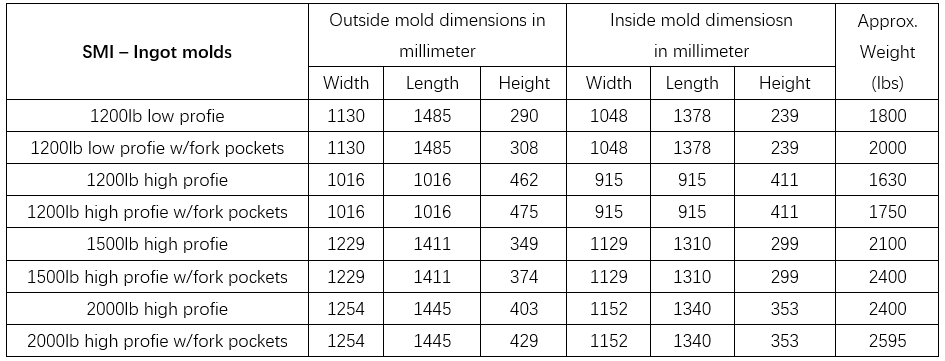
We offer Ingot molds with many sizes of standard, low-profile and high-profile, and with or without fork pockets as in the table below. Our molds are cast from a proprietary material, the material is developed by our own to provide a very good durability.

In addition to our proprietary material, we also supply other conventional steel molds and ductile iron molds, the material will be ASTM A27 Gr 70-40, ASTM A148 Gr 105-85, AISI 8630, GGG-40, GGG-50 and other materials that customers want, contact us to find the best solution for your company.

SMI - Ingot Molds
SMI – Ingot Molds

Filed Under: Casting Consumables Tagged With: aluminium casting, casting consumables, Ingot Mold, ingot mould, metal ingot

  • Page 1
  • Page 2
  • Page 3
  • Interim pages omitted …
  • Page 16
  • Go to Next Page »

Primary Sidebar

  • Home
  • About Us
  • Industries Served
    • SMI Products Overview
      • SMI Special Steel Products 01
      • SMI Special Steel Products 02
      • SMI Metal Recycling
      • NDT (Non Destructive Testing) service
  • Capabilities
    • Aluminum Industry
      • Aluminum Dross Press
      • Aluminum Dross Cooling Pan
      • Alloy Steel Sow Mold
      • Aluminum Dross Skim Blades and Skim Tools
      • Aluminum Furnace Skimming Tool or Skim blades used for Stirring and Mixing
      • Dross Press & Dross Processing
      • Application of Intelligent Ladle Slag Scraper (Skimming Tools) in steel mills and aluminum mills
      • Transmission Parts
      • The correct combination of the press head and the dross pan
      • 7-9kgs Small Standard Ingot Molds | Moldes de lingotes estándar pequeños de 7-9kgs
      • Comparison between Sow Molds and Ingot Molds
      • Aluminum Dross Transport Equipment
      • Aluminum Dross Recycling Systems
      • Aluminum, Magnesium, Brass, Bronze, Lead, Zinc Ingot Molds
      • Anode steel claw (Electrolytic claw) | Garra de acero del ánodo (garra electrolítica)
      • Anode Steel Yoke
  • eNews
  • Contact Us

Footer

Customized Products & Services

Professional Aluminum & Magnesium plant equipment supplier from China.
Up to 4,000 metric tons of mechanical products annually.
More than 30 years’ manufacturing and export experience.
Serving Global Aluminum & Magnesium smelters and metal recycling industry since 1996.

Recent Products & Services

  • High-Performance Aluminum Ingot Molds: The Complete Selection Guide
  • Casting vs Forging vs Machining: Choosing by Wear Mechanism
  • Ingot Mold Failure Modes: Causes, Prevention & Lifespan Tips
  • Global OEM Supply Chain: Heavy-Duty Crusher Wear Parts Manufacturing
  • Dross Pan Cover: Oxygen Barrier, Not Insulation

Found favorite parts & services

Sino Machine Industries — Heavy Industry Supplier with 30 Years of Manufacturing Expertise in Aluminium, Crushing & Transmission Parts. Serving primary smelters, recycling plants and OEM clients across 30+ countries. Get a free quote: [Inquiry@sinomachine.org]
  • Home
  • Privacy Policy
  • Terms of Use
  • Download Center
  • Site Map
  • Contact Us

Copyright © 2026 Sino Machine Industries (SMI) Serving Global Machinery Markets Since 1996