• Skip to main content
  • Skip to primary sidebar
  • Skip to footer

Sino Machine Industries

  • Home
  • About Us
  • Industries Served
    • SMI Products Overview
      • SMI Special Steel Products 01
      • SMI Special Steel Products 02
      • SMI Metal Recycling
      • NDT (Non Destructive Testing) service
  • Capabilities
    • Aluminum Industry
      • Aluminum Dross Press
      • Aluminum Dross Cooling Pan
      • Alloy Steel Sow Mold
      • Aluminum Dross Skim Blades and Skim Tools
      • Aluminum Furnace Skimming Tool or Skim blades used for Stirring and Mixing
      • Dross Press & Dross Processing
      • Application of Intelligent Ladle Slag Scraper (Skimming Tools) in steel mills and aluminum mills
      • Transmission Parts
      • The correct combination of the press head and the dross pan
      • 7-9kgs Small Standard Ingot Molds | Moldes de lingotes estándar pequeños de 7-9kgs
      • Comparison between Sow Molds and Ingot Molds
      • Aluminum Dross Transport Equipment
      • Aluminum Dross Recycling Systems
      • Aluminum, Magnesium, Brass, Bronze, Lead, Zinc Ingot Molds
      • Anode steel claw (Electrolytic claw) | Garra de acero del ánodo (garra electrolítica)
      • Anode Steel Yoke
  • eNews
  • Contact Us
You are here: Home / Archives for Aluminium Industry Equipment

Aluminium Industry Equipment

October 28, 2025 By Coffy Leave a Comment

Dross Pan Cover: Oxygen Barrier, Not Insulation

Dross Pan Cover: Why It Is an Oxygen Barrier, Not an Insulation Blanket

Ask anyone what a lid does to a hot container and the answer is immediate: it traps heat and slows cooling. That everyday thermal logic fails completely on freshly skimmed aluminium dross — but not for the reason usually given. A dross pan cover does not speed up cooling by “trapping heat in and starving the fire.” It works because hot dross is not a passive heat mass at all — it is a self-heating one, and the cover stops the heat source rather than improving heat extraction.

Key figures
  • Hot dross is skimmed at roughly 680–780 °C — well above the point where metallic aluminium self-heats in air
  • Open pan, uncontrolled: cooling to a safe temperature can take up to 12 hours. Covered with inert gas: well under 4 hours
  • 60–85% of the cooling duty is done by the pan body acting as a heat sink — not by the cover
  • Below about 400 °C, oxidation and aluminothermic reaction stop and metal is no longer lost

1Why the Intuition Breaks Down

Hot water in a covered pot cools more slowly. Nothing about that changes here — a cover does suppress surface convection, and in a purely passive system it would slow cooling down. What breaks the analogy is that hot dross is not passive.

Freshly skimmed white dross leaves the melting or holding furnace at roughly 680–780 °C — a temperature operators read by colour, deep red when too cold and bright yellow-white when too hot. It is a heterogeneous mix of free metallic aluminium droplets, alumina, aluminium nitride and minor salt flux residues. At that temperature, metallic aluminium exposed to air undergoes a self-sustaining exothermic oxidation, widely called thermiting or dross burning:

4Al + 3O2 → 2Al2O3 + heat

This is the point most explanations miss. In an open pan, the dross is not simply losing heat to its surroundings — it is continuously generating new heat for as long as oxygen keeps arriving. Radiation and natural convection are partly offset by that internal heat source. The smoke and fume above an open pan are fine alumina particulates from aluminium vapour and surface combustion, and they are visible evidence of metal being destroyed in real time.

The reaction self-feeds until one of two things happens: the dross temperature falls below roughly 400 °C, at which point oxidation and the aluminothermic phenomenon stop and metal is no longer lost — or the oxygen supply is cut off. A cover addresses the second route.

2What a Cover Actually Does — and What It Does Not

Here is where a lot of casthouse folklore goes wrong, and it is worth being precise because the difference has real commercial consequences.

A cover dropped onto a pan is not a sealed vessel. Air continues to infiltrate through the gap between cover and pan rim, through the aluminium drain holes in the base of a press dross pan (or the ventilation openings in a skim pan base), and around any lifting point. Oxygen trapped in the headspace is consumed within seconds, but it is then replenished. A cover on its own slows oxidation at the exposed surface; it does not reliably extinguish it.

The industrial solution — the Alcan dross cooler design, patented in the early 1990s and still in service at primary casthouses including Ma’aden’s ingot, billet and slab lines — uses three elements together:

  • A compartmentalised pan sized as a heat sink — the patent specifies a pan-to-dross weight ratio of at least 1:1, preferably 1.5:1 to 2:1
  • A hood or cover forming a substantially closed cavity around the filled pan, sealed at the base by a sand bed, refractory wool gasket or machined seat
  • Inert gas injection through a valve in the hood — preferably argon, because nitrogen reacts with molten aluminium and is therefore not recommended for aluminium dross — maintaining positive pressure so air cannot infiltrate

It is the gas that does the oxygen displacement, and it is the positive pressure that keeps air out. The cover’s job is to make that gas volume small enough to be economically purged and held.

Where the heat actually goes

The second half of the correction matters just as much. In the Alcan design, 60–85% of the cooling is done by heat exchange with the pan itself — the pan body absorbs the heat the dross releases. The patent is explicit on the geometry this requires: no dross more than 0.5 m from the nearest pan surface, and a pan surface area exposed to dross of at least 5.0 m², preferably 9.0 m², per cubic metre of pan capacity.

So the correct statement is a two-part one: the pan body removes the heat; the cover stops more heat being made. Remove the internal heat source and the sensible heat remaining in the dross dissipates through the pan walls and cover by conduction and radiation — and the net effect is a dramatically shorter cooling cycle. This is also why pan mass is not a cost to be engineered out. It is the heat sink.

3The Numbers Worth Quoting

Cooling-time claims circulate widely in this industry and most of them are unsourced. Here are two figures that are not:

  • Open pan, uncontrolled: cooling to a safe, non-reactive temperature is generally completed within a maximum period of twelve hours, with the actual period depending on the metal content of the dross and its major alloying constituents
  • Covered with inert gas: one-tonne lots of partially incandescent (yellow heat) dross were cooled safely to below 400 °C in well under four hours

Industry literature describes pans being held under the inert atmosphere for roughly 4–7 hours until the temperature drops below 400 °C — a figure carried in AlCircle’s Aluminium Dross Processing: A Global Review, whose technology-evolution section draws on David J. Roth’s industry paper History & Future of Dross Processing (Light Metals 2015). Whatever the exact figure at your plant, the shape of the comparison is consistent and large: a covered, oxygen-displaced pan reaches a safe temperature in a fraction of the time an open pan needs.

On quoting a percentage. You will see “covers cut cooling time by 50%” stated as fact in supplier literature. We have not been able to trace that figure to any published test data, and we do not use it. Actual results depend on dross metal content, alloy, pan mass ratio, fill level and ambient conditions. If you want a number for your casthouse, it has to come from a trial on your dross — and we would rather help you run one than hand you a figure we cannot stand behind.

4Where a Cover Fits — and Where It Does Not

The mechanism only produces a benefit while the dross is still hot and reactive. Three limits are worth stating plainly:

  • Cold dross — no benefit. Once dross has fully cooled and oxidation has stopped, a cover behaves like any conventional lid: it slows heat loss. Covering cold dross achieves nothing beyond dust containment.
  • White dross — largest benefit. White (primary) dross typically contains roughly 15–80% metallic aluminium. There is a lot of metal to lose, so stopping thermiting pays.
  • Black dross — limited benefit. Black (secondary) dross runs roughly 2–20% metallic aluminium with high salt and oxide content. There is far less free metal to oxidise, so the recovery gain from oxygen exclusion is correspondingly smaller.

5Covers and Dross Presses — Different Stages, Not Alternatives

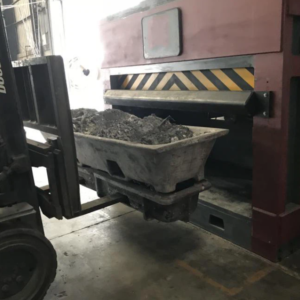
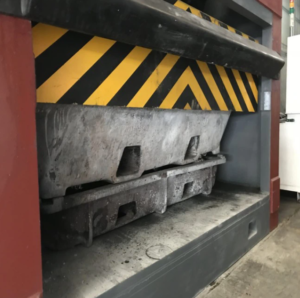
In most casthouses we supply, there is no lid on the pan at all — and that is a perfectly complete process. The perforated pan set is filled at the furnace, moved by forklift straight into the dross press, and the press head itself closes the pan, arrests thermiting and squeezes the free metal out within minutes. Nothing is left to cool in the open.

A cover belongs to a different stage: where hot dross — or pressed salt cake — is set aside to cool in the pan rather than being processed immediately. In that route there is no press head available to do the closing, and the cover becomes the only barrier between the dross and the air.

So the two are neither competing alternatives nor a required pair. They sit at different points in the flow:

  • Pressing route — no cover needed. The press head performs the sealing and the cooling. Operations with sufficient press capacity and a short furnace-to-press distance may never require a lid.
  • Staged cooling route — cover applies. Where pans are parked to cool before further handling, whether hot dross or pressed salt cake, a cover is used to close the oxidation window that would otherwise stay open.

Where a cover is used for post-press salt cake, it serves the same duty as our aluminium dross cooling pan — moving the material quickly through the reactive temperature band.

6Safety: A Cover Must Never Fully Seal

Hot aluminium dross is not merely hot material — it is a regulated hazardous residue. In transport it is classified UN 3170, Class 4.3, placarded DANGEROUS WHEN WET, and it is listed by name in the IMSBC Code (Group B). Under Chinese regulation, aluminium dross and secondary aluminium dross are listed hazardous wastes — codes 321-024-48 / 321-026-48, hazard characteristic R (reactivity) — classified under GB 5085.5 reactivity testing for exactly the reason below.

That hazard is water reactivity. Contact with moisture releases three gases at once, not one:

  • Ammonia (NH3) from aluminium nitride — AlN + 3H2O → Al(OH)3 + NH3. Toxic and irritant.
  • Hydrogen (H2) from finely divided metallic aluminium — 2Al + 6H2O → 2Al(OH)3 + 3H2. Flammable and explosive.
  • Methane (CH4) from aluminium carbide — Al4C3 + 12H2O → 4Al(OH)3 + 3CH4. Flammable and explosive.

Testing on dross samples from six large secondary aluminium plants recorded ammonia release of 43.1–68.8 mg/kg and hydrogen evolution of 0.5–1.5 L/(kg·h) — every sample reacted. Both the IMSBC Code and ERG Guide 138 therefore prohibit water as an extinguishing medium: dry sand, dry powder or Class D media only.

The practical consequence is the one that matters here: a gas-generating material of this kind must not be sealed into a closed vessel.

The engineering requirement is therefore substantially closed, not hermetically sealed. The reference designs achieve this with sand seals, refractory wool or high-temperature gaskets at the base of the hood — a sand seal additionally avoids the hazards associated with older water-seal designs — and the cavity is held at slight positive pressure with inert gas. Degassing paths must be preserved, and covers should be specified with that requirement stated explicitly on the drawing.

7What to Specify When Ordering a Cover

Covers are manufactured against the pan they sit on. There is no catalogue item, because the sealing geometry is defined by the pan rim. To get an accurate quotation and a correct engineering recommendation, include:

  1. Pan drawings or dimensional sketch — rim profile, overall dimensions, aluminium drain hole layout
  2. Whether inert gas will be injected, and which gas — this determines the sealing specification and whether a gas port is required
  3. Dross type and temperature at filling — white, black or mixed; expected metal content
  4. Handling method — forklift, overhead crane, or dedicated lifting frame; lifting lug positions required
  5. Material grade required, or the operating conditions and observed wear pattern if you want a recommendation
  6. Quantity, and whether this is a one-off replacement or a fleet-wide programme

And hold the supplier to the same standard in return: material grade named, tare weight, lifting lug rated capacity, expected service life and warranty terms with the conditions they assume, production drawings issued for approval before manufacture, tiered pricing, and delivered pricing quoted separately from ex-works.

In One Sentence

A dross pan cover is not an insulation blanket. It is an oxygen barrier that stops hot dross generating its own heat, working alongside a pan body heavy enough to carry the heat away. The confusion casthouse engineers feel on first hearing it — how can a lid make hot material cool faster? — resolves once you stop thinking about heat extraction and start thinking about the heat source.

Further reading: key design features of SMI skim pans, slag bins and sow moulds — including pan mass, chamber geometry and rim reinforcement.

Next step

Send SMI your pan drawings for a cover review and quotation

Filed Under: Dross Management

October 13, 2025 By Coffy Leave a Comment

Aluminum Dross Press & Dross Processing: Equipment, Recovery and Applications

Aluminum Dross Press & Dross Processing

Sino Machine Industries (SMI) supplies aluminum dross press systems and related casthouse equipment for primary aluminum smelters, secondary aluminum producers, aluminum casting facilities and metal recycling operations. Since 1996, SMI has served the aluminum and metal recycling industries with equipment and customized industrial products designed around specific operating requirements.

Our product scope includes aluminum dross presses, dross press heads, dross pans, cooling pans and associated cast-house components. Depending on the project, equipment may be supplied individually, as matched component sets, or as part of a broader dross management and metal recovery solution.

Aluminum Dross Processing: Why Equipment Selection Matters

Aluminum dross is generated during melting, holding, alloying and other molten-metal operations. Its composition varies with furnace type, alloy, operating conditions, flux use, handling practices and the time elapsed after skimming.

Depending on its origin and condition, dross may contain recoverable metallic aluminum, aluminum oxides, flux salts and other constituents. The proportion of recoverable metal is not constant across all dross streams.

Effective dross management therefore requires more than selecting a press with a particular rated capacity. The process must account for how dross is generated, transferred, pressed, cooled, transported and subsequently processed.

A properly specified hot aluminum dross press can help recover free metallic aluminum at the casthouse before the material undergoes further oxidation. Its actual performance depends on the dross characteristics, operating procedures, press configuration, cooling arrangement and measurement method.

How an Aluminum Dross Press Works

An aluminum dross press is designed to separate recoverable metallic aluminum from freshly skimmed hot dross through controlled mechanical pressing.

A typical operating sequence includes the following stages:

1. Dross skimming and collection

Dross is removed from the furnace and collected in a suitable dross pan. Prompt and controlled transfer is important because prolonged exposure to high temperatures and air can increase oxidation and reduce the amount of recoverable metallic aluminum.

2. Positioning and pressing

The loaded pan is positioned in the press according to the equipment design. The press head applies controlled hydraulic force to compact the hot dross and promote the discharge of liquid aluminum through the designed drainage passages.

3. Metal collection

The separated metallic aluminum is collected for appropriate return to the melting process or other suitable handling, subject to alloy quality and plant procedures.

4. Cooling and residue handling

The remaining dross or salt-bearing residue is handled and cooled using a procedure appropriate to its composition and the installation. The subsequent treatment route depends on the material characteristics and applicable safety and environmental requirements.

A dross press is one stage of an overall recovery process. It does not, by itself, eliminate the need for downstream treatment or appropriate management of the remaining residue.

SMI Aluminum Dross Press Systems

SMI offers dross press equipment for different production requirements, including small and medium-sized melting and casting facilities and larger aluminum production operations.

The existing SMI product range includes three model designations:

  • SMI40: A smaller-capacity configuration.
  • SMI60: A medium-capacity configuration.
  • SMI80: A larger-capacity configuration.

The historical SMI product specification lists nominal single-cycle dross capacities of approximately 250–300 kg for SMI40, 450–500 kg for SMI60 and 600–700 kg for SMI80. These figures should be treated as preliminary selection references and verified against the current equipment specification and the customer’s actual dross characteristics.

The appropriate configuration should be determined by considering the quantity of dross generated per cycle, the number of furnaces served, the operating schedule, available handling equipment and the required cycle time.

Customized configurations may be considered where the standard arrangement does not match the installation requirements.

Dross Press Heads and Dross Pan Sets

The press head and dross pan are closely related components in a hot dross pressing system. Their geometry, clearances, drainage arrangements and thermal behavior affect the operation of the equipment.

SMI supplies dross press heads and dross pan sets in configurations selected according to the press design and customer requirements.

Important considerations include:

  • Existing press frame and head dimensions.
  • Pan geometry, capacity and drainage-hole arrangement.
  • Material selection and resistance to thermal cycling.
  • Forklift pockets, lifting points and handling clearances.
  • Compatibility between the press head, pan and operating cycle.
  • Cooling arrangements and the condition of existing equipment.

Where replacement components are required for an existing installation, drawings, dimensional sketches, photographs and equipment identification details help establish compatibility before production.

For third-party equipment, suitability must be confirmed through an engineering review rather than assumed from nominal dimensions alone.

Dross Cooling and Downstream Processing

Hot dross pressing and downstream dross recycling perform different functions and should be evaluated separately.

After pressing, the remaining material may still contain metallic aluminum trapped within an oxide-rich matrix. Depending on the dross type and the recovery objective, additional processing may include controlled cooling, crushing, screening and separation.

A typical downstream arrangement may include:

  • Dross cooling equipment.
  • A suitable crushing or milling stage.
  • Screening and classification equipment.
  • Collection and handling systems for separated fractions.
  • Dust control and residue management equipment, where required.

Not every plant needs the same configuration. The appropriate process depends on whether the feed is primary or secondary dross, whether flux salts are present, the residual metal content, the intended recovery route and local environmental requirements.

Salt-bearing residues from secondary aluminum operations may require dedicated treatment. Mechanical pressing should not be regarded as a complete salt-slag treatment process.

Aluminum Dross Management, Safety and Environmental Considerations

Modern dross management involves more than maximizing the quantity of recovered metal. Material handling, cooling, storage, transportation, worker protection and the management of processing residues are also important.

The International Aluminium Institute’s 2026 Sustainable Aluminium Dross Management Guidance emphasizes an integrated approach to dross generation, handling, cooling, processing, recovery, safety and residue utilization.

For equipment selection and plant planning, the following principles are relevant:

  • Establish a defined procedure for hot-dross handling and transfer.
  • Select cooling and processing methods appropriate to the material.
  • Assess dust, heat, moving machinery and other workplace hazards.
  • Provide suitable guarding, interlocks and operating controls for the specified installation.
  • Evaluate residue composition and the applicable treatment or disposal requirements.
  • Review local environmental, transport and waste regulations before determining the final processing route.

Certain aluminum dross and salt-bearing residues can release hazardous or flammable gases when exposed to unsuitable treatment conditions, including uncontrolled contact with water. Residue treatment must therefore be based on its actual composition and an appropriate process-safety assessment.

Environmental performance and regulatory compliance depend on the complete operating system, not on the press alone.

Applications

SMI dross press equipment and related casthouse products may be relevant to:

  • Primary aluminum smelters.
  • Secondary aluminum smelters and remelting plants.
  • Aluminum billet, bar and rod production facilities.
  • Aluminum casting and foundry operations.
  • Aluminum recycling and metal recovery plants.
  • Non-ferrous metal processing facilities, subject to material and process compatibility.

Equipment selection should reflect the specific production process rather than the industry label alone.

Selecting the Right Dross Press Configuration

A useful technical assessment begins with the customer’s existing process and operating requirements.

To help evaluate a new system or replacement equipment, please provide as much of the following information as available:

  • Furnace type, number of furnaces and production process.
  • Dross type and approximate quantity generated per shift.
  • Typical dross weight per pan or pressing cycle.
  • Existing press model, press-head dimensions and pan drawings.
  • Available floor space and material-handling arrangements.
  • Hydraulic, electrical and cooling-water requirements, where applicable.
  • Required automation level and intended scope of supply.
  • Applicable inspection, documentation and safety requirements.

These details help establish a suitable configuration, identify compatibility issues and determine whether a complete press system or selected replacement components would better meet the requirement.

SMI: Dross Press Equipment and Customized Industrial Components

Sino Machine Industries supplies aluminum dross press equipment and related industrial components for aluminum production and recycling applications. Our scope can include complete equipment packages, matched press-head and dross-pan sets, cooling pans and customized cast components, depending on the project.

We work from the customer’s drawings, specifications and operating requirements to evaluate the appropriate product configuration. Equipment scope, technical parameters, inspection arrangements and delivery requirements are established for each individual project.

For related information, please explore our aluminum dross press systems, dross press heads and dross pan sets, aluminum dross cooling pans, casthouse skimming tools and aluminum dross recycling equipment.

Request Technical Information or a Quotation

If you are planning a new dross press installation, replacing existing components or reviewing your current dross recovery process, SMI welcomes your enquiry.

Please send your equipment drawings, current specifications, approximate dross volume and intended scope of supply to inquiry@sinomachine.org.

Our team can review the available information and advise on a suitable equipment or component configuration for your application.

Filed Under: Aluminium Industry Equipment, Dross Management, Dross Press & Dross Processing, Metal Recycling, Recycling, Recycling, New energy and Environmental protection

January 10, 2025 By Sen Liang Leave a Comment

Dross Stir Blades and Dross Skim Blades (Dross Skim Tools)

Dross Skim Blades and Dross Skim Tools

Dross skim blades (Dross Skimming Tools) are often the headaches in the casthouse operation because of the usual short life expectancy. SMI specially designed skim blades, made out of our proprietary material, usually last substantially longer than the traditional ones. Show us your reverberatory furnace and the skim blade handling equipment, we will offer you our skim blades to fit for your application for longer service life.

Dross skim tools including the following series:
CAST STIR BLADE series, CAST SKIM BLADE series, CAST LOCK PINs, NUTs and SCREWs. Let us know your production environment and we will tell you how to choose dross stir blade, how to choose skim blade and the appendages.

Las cuchillas de escoria (Dross Skimming Tools) son a menudo los dolores de cabeza en la operación de la fundición debido a la corta esperanza de vida habitual. Las cuchillas desnatadas especialmente diseñadas por SMI, hechas de nuestro material patentado, suelen durar mucho más que las tradicionales. Muéstrenos su horno de reverbero y el equipo de manejo de cuchillas desnatadas, le ofreceremos nuestras cuchillas desnatadas que se adaptan a su aplicación para una vida útil más larga.

Οι λεπίδες Dross skim (Dross Skimming Tools) είναι συχνά οι πονοκέφαλοι στη λειτουργία του χυτοστασίου λόγω του συνηθισμένου μικρού προσδόκιμου ζωής. Οι ειδικά σχεδιασμένες λεπίδες αποκορύφωσης SMI, κατασκευασμένες από ιδιόκτητο υλικό μας, συνήθως διαρκούν σημαντικά περισσότερο από τις παραδοσιακές. Δείξτε μας τον κλίβανο αντήχησης και τον εξοπλισμό χειρισμού λεπίδων αποκορύφωσης, θα σας προσφέρουμε τις λεπίδες αποκορύφωσης που ταιριάζουν στην εφαρμογή σας για μεγαλύτερη διάρκεια ζωής.

Filed Under: Furnace Tools & Accessories Tagged With: aluminium dross, dross skim blades, dross stir blades, furnace tools, skimming tools

January 9, 2025 By Sen Liang Leave a Comment

Comparison between Sow Molds and Ingot Molds

Comparison between Sow Molds and Ingot Molds, covering shape, materials, functions, applications, replacement frequency, and other key differences:

1. Shape & Structural Design
Aspect Sow Molds Ingot Molds
Typical Shape – Thick, block-like (trapezoidal or rectangular, 500–2,000 kg) – Slender, standardized bars (“T” or trapezoidal, 20–25 kg)
– Rough surface, minimal internal features – Smooth surface, precise dimensions
Dimensions – Example: 1.5m × 0.6m × 0.5m (for 1,000 kg ingots) – Example: 0.8m × 0.15m × 0.1m (for 25 kg ingots)
Internal Design – Reinforced for bulk strength (fewer ribs) – Multiple ribs (to prevent warping)
– Simple interior surface – Mold release slopes or grooves
2. Manufacturing Materials
Aspect Sow Molds Ingot Molds
Primary Materials – Gray cast iron (HT250): Low cost, heat-resistant – Gray cast iron (HT200): Lightweight
– Ductile iron (QT500-7): Superior thermal shock resistance – Low-carbon steel (Q235B): For rapid cooling
– High-chromium cast iron (Cr 15–20%) – Nickel-plated variants (anti-stick)
Material Properties – High thermal conductivity – Moderate thermal conductivity
– Carbon content: 3.0–3.5% (gray iron) – Carbon content: 2.5–3.2% (gray iron)
3. Function & Applications
Aspect Sow Molds Ingot Molds
Primary Function – Cast large aluminum blocks (“sows”) for remelting or rolling – Produce standardized ingots for direct sale or machining
– Focus on slow cooling to preserve metal quality – Prioritize rapid solidification and surface finish
Applications – Primary smelters (electrolytic aluminum) – Downstream processing plants (e.g., extrusion, forging)
– Recycling plants (bulk scrap remelting) – Commercial trade (standardized units)
Cooling Method – Natural cooling (4–8 hours) – Forced cooling (water/air jets, 10–30 minutes)
– Insulation layers (e.g., ceramic blankets)  
4. Replacement Frequency & Maintenance
Aspect Sow Molds Ingot Molds
Service Life – 300–500 pours (prone to thermal cracking) – 1,000–1,500 pours (lightweight design)
– Repairable via welding – Less frequent repairs
Failure Modes – Thermal fatigue cracks (interior surface) – Surface oxidation peeling
– Warping (difficulty demolding) – Dimensional inaccuracy due to wear
Maintenance – Inspect for cracks every 50 uses – Clean slag every 100 uses
– Apply anti-stick coatings (e.g., graphite) – Calibrate dimensions periodically
5. Industry Use Cases
1) Sow Molds Example:
An electrolytic aluminum plant uses HT250 gray iron sow molds to cast 1,200 kg blocks for rolling mills. Molds are replaced every 6 months.
2) Ingot Molds Example:
An extrusion factory employs Q235B steel ingot molds to produce 22.5 kg T-shaped ingots at 200 units/hour, with a mold lifespan of 2 years.
6. Key Differences & Selection Guidelines
Factor Sow Molds Ingot Molds
Design Focus Bulk casting, slow cooling, durability Standardization, speed, surface quality
Ideal Scenario Primary smelting or remelting Downstream processing or trade
Cost Efficiency Higher initial cost, saves remelting energy (~15%) Lower cost, mass production efficiency (~30% faster packaging)
Recommendations:
1) Use Sow Molds for intermediate products requiring remelting or rolling.
2) Choose Ingot Molds for final products needing standardized shapes and fast turnover.

This comparison highlights how material choices, design priorities, and operational needs drive the selection between these critical aluminum casting tools. For more professional guidance, please contact our aluminium casting engineer.

Filed Under: Casting Consumables Tagged With: aluminium casting, casting comparison, Ingot Mold, ingot mould, Sow Mold, sow mould

February 1, 2024 By Sen Liang Leave a Comment

Aluminum Dross Press

Aluminum Dross Press — In-House Dross Recovery Systems for Aluminum Casthouses

An aluminum dross press is the most effective method for recovering free metal from hot aluminum dross at the point of generation — before oxidation converts recoverable aluminum into oxide waste. By combining hydraulic compaction with forced cooling in a single automated cycle, a correctly specified dross press system typically achieves 20–35% in-house metal recovery, depending on operational conditions at the casthouse.

SMI designs, manufactures and commissions aluminum dross press systems as a complete supply — from the press frame and hydraulic unit through to the dross press cooling head, dross pan set and control system. Developed with over 30 years of experience in the aluminum recycling industry, SMI delivers dross press systems as engineered solutions matched to each customer’s furnace type, dross generation rate and casthouse configuration.

Aluminum Dross Press of Aluminum Dross Recovery

Why In-House Dross Processing Matters

Hot aluminum dross leaving the furnace still contains significant free metal — the exact proportion depending on furnace type, alloy, operating practice and how quickly the dross is handled after skimming. Without on-site pressing, dross is typically cooled slowly in open pans, allowing continued oxidation and thermiting that converts recoverable aluminum into aluminum oxide. This represents a direct and measurable production loss on every cast.

Sending unpressed dross to an external recycler recovers some of that metal, but at a fraction of its in-house value and with significant commercial and logistical dependencies. In-house pressing recovers the metal immediately, at full in-house value, and gives the operation direct control over its dross processing output.

Actual recovery rates in practice depend on several operational factors: the free metal content of the dross at skimming, the time elapsed between skimming and pressing, the distance from furnace to press, insulation conditions during transfer, and the condition of the pan-and-head set. The global average in-house aluminum recovery from dross processing is approximately 33% — SMI systems are designed to optimise all controllable variables within this range.


SMI Dross Press — Three Model Sizes

SMI supplies three standard dross press models, sized to match different furnace capacities and dross generation rates. All three models share the same engineering platform — hydraulic system architecture, control system, cooling head technology and dross pan design — with press capacity scaled to the installation requirement.

Model Single-Cycle Dross Capacity Typical Application
SMI40 250–300 kg per pressing cycle Smaller melting and casting facilities, secondary smelters, foundries
SMI60 450–500 kg per pressing cycle Medium-capacity primary and secondary smelters, recycling plants
SMI80 600–700 kg per pressing cycle High-volume primary smelters, large secondary operations

Custom configurations outside these standard ranges are available on request. Press capacity selection, pan geometry and cooling head specification are confirmed by SMI application engineers based on a review of the customer’s furnace type, dross generation rate and casthouse layout.


How the SMI Dross Press System Works

The SMI dross press operates on a fully automated, programmable cycle integrated with the casthouse workflow:

  • Hot dross is skimmed from the furnace and transferred directly to the dross pan — minimising the time between skimming and pressing is critical to maximising recovery
  • The loaded dross pan is positioned in the dross press box
  • The hydraulic cylinder drives the cooling head down into the dross box, compacting the dross under controlled pressure
  • The integrated cooling system activates simultaneously, extracting heat rapidly through the cooling head and arresting oxidation
  • The dross consolidates into a dense aluminum block with significantly reduced oxide content
  • The head retracts, the cycle completes, and the press is ready for the next pan

No manual intervention is required during the press cycle. Cycle parameters — pressure, hold time, cooling duration — are set to match the dross type and production rate of the specific installation. The automated operation reduces operator exposure to radiant heat and fume, and eliminates the skill variability associated with manual dross handling.


System Components and Specifications

Press Frame and Hydraulic System

The press frame is engineered for the compaction forces and thermal environment of continuous casthouse operation. The complete machine weight is approximately 15 tonnes. The hydraulic system is sized to the press capacity requirement and supplied as an integrated part of the press package.

SMI specifies hydraulic and electrical components from established global industrial suppliers as standard — pumps and valves from Rexroth, additional valves from SUN, filtration from HYDAC, and drive motors from Siemens. Alternative brands are available as specified by the customer. Component brand selection affects price, local serviceability, warranty terms and spare parts availability — SMI application engineers will advise on the most practical specification for each market and installation. In the event of on-site replacement, locally available motors and components of equivalent power and performance specification are fully compatible.

Dross Press Cooling Head

The dross press cooling head is the core performance component of the system. It delivers the compaction force and simultaneously extracts heat through an integrated forced-cooling circuit cast directly into the head body. SMI cooling heads are manufactured from the proprietary SMI ATM series anti-thermal-shock castable and are available in cooled and uncooled configurations across all geometries. The cooling head and dross pan are designed as a matched set to optimise seal geometry and heat transfer performance.

Dross Pan Set

The dross pan is the containment and transfer vessel for hot dross from furnace to press. SMI dross pans are cast from proprietary alloy steel formulations developed to resist the thermiting action and thermal shock of continuous hot dross service. Pan geometry is matched to the cooling head profile to ensure correct sealing under press pressure. Dross pan sets and press heads are manufactured and supplied to exact customer requirements for any dross press configuration.

Control and Automation System

The control system manages the full press cycle — hydraulic actuation, cooling circuit activation, pressure hold, cycle timing and head retraction — through a programmable controller. The system is designed for straightforward day-to-day operation and maintenance, with alarm and monitoring functions as standard. Remote monitoring capability is available as part of the control package.


System Design Considerations

SMI dross press system design takes into account the full operational context of each installation:

  • Furnace configuration — type, capacity and number of furnaces to be served
  • Material handling — forklift capacity, pan transfer method, casthouse layout and access
  • Dross characteristics — type, generation rate, free metal content and temperature at skimming
  • Utility supply — hydraulic, cooling water and electrical specifications
  • Recovery objectives — on-site recovery targets and downstream processing requirements

The goal of the design process is a system that maximises recovery both on-site and at any downstream secondary processor, within the operational and physical constraints of the specific casthouse.


Upgrade and Retrofit Supply

For operations with existing dross press installations, SMI provides upgrade and retrofit supply across the consumable and component range. If the press frame is serviceable but recovery performance has declined — due to worn cooling heads, degraded dross pans or control system limitations — SMI can supply replacement components without requiring full press replacement.

SMI cooling heads can be adapted to work with third-party press frames. Because hydraulic output, control parameters and commissioning requirements vary between press manufacturers, SMI conducts a technical review of the existing press specifications before confirming the adaptation scope. The full delivery scope — engineering review, component manufacture, on-site installation and commissioning — is available as a single-source engagement.


Delivery and Service

Parameter Details
Lead time Approximately 6~10 weeks from order confirmation
Shipping Ocean freight, 1 x 40HD container
Delivery terms DDP available; other Incoterms on request
On-site service Installation and commissioning support available
Spare parts Replacement cooling heads, dross pans and hydraulic components held in stock

Global Supply and Service

SMI has been supplying aluminum recycling systems and casthouse consumables since 1996, with over 30 years of manufacturing and export experience across legal entities in mainland China, Hong Kong, Southeast Asia, Europe and the United States. Annual mechanical product output exceeds 4,000 metric tons.

SMI dross press systems and casthouse consumables are in active service at primary aluminum smelters across the Middle East, Europe, India, North America and Asia-Pacific, including multiple operations within the world’s highest-output primary aluminum production groups. All supply relationships are subject to confidentiality agreements. Reference accounts are available to qualified buyers under appropriate confidentiality terms.


Application Sectors

  • Primary aluminum smelters
  • Secondary aluminum smelters and refineries
  • Aluminum rod, billet and bar plants
  • Metal recycling and non-ferrous scrap processing plants
  • Aluminum die casting and foundry operations
  • Magnesium and other non-ferrous metal recovery operations

Related Products — Complete Dross Management from SMI

  • Dross Press Cooling Head — cooled and uncooled variants, all geometries, matched to pan set
  • Dross Press Equipment Overview — system configurations, capacity planning and upgrade options
  • Dross Skim Pans and Sow Molds — pan-and-head matched sets, proprietary alloy steel
  • Aluminum Dross Cooling Pan — rapid salt cake cooling post-press
  • Dross Skim Blades and Casthouse Skimming Tools
  • Aluminum Dross Recycling Systems — full downstream processing: stirrer, cooler, crusher, screening and dust collection
  • Alloy Steel Sow Molds
  • Alloy Steel Ingot Molds, Sow Molds and Dross Pans for Aluminum Scrap Recycling

Request a System Quotation or Technical Consultation

To specify the correct dross press system for your operation, please provide the following at enquiry stage:

  • Furnace type and number of furnaces to be served
  • Estimated dross generation rate — tonnes per shift or pans per hour
  • Dross type: primary / secondary / rotary / other
  • Existing dross handling equipment — press frame, pan set, cooling system if applicable
  • Available utilities: hydraulic supply, cooling water, electrical specification
  • Casthouse layout drawing or dimensional constraints if available

SMI will respond with a written system recommendation and commercial proposal. Contact SMI — Aluminum Dross Press Enquiry →

Filed Under: Dross Management Tagged With: aluminium dross, Dross Press, dross processing equipment, metal recovery, secondary smelter

January 9, 2024 By Sen Liang Leave a Comment

Aluminum Dross Skim Blades and Skim Tools

Aluminum Dross Skim Blades

Aluminum dross skim blades (skim tools) is a management tool for aluminum dross in smelting furnace, and skim blade is used to remove or skim the dross layer on the surface of the furnace melt to help obtain better aluminum. SMI’s skim blades are made of our own developed corrosion-resistant, wear-resistant materials and can be used in various vehicles such as wheel loaders and forklifts.
It is composed of scraper rod and scraper plate, only need to replace the scraper plate
Increase of service life, Reduced downtime, Cost saving

One end of the skim blades (skim tools) is connected to a long rod that is resistant to high temperature and corrosion by means of a fixing bolt, and the other end is fixed to the forklift. Can move with the telescopic arm before and after, left and right, up and down, so that the aluminum dross more uniform heat distribution and melting, and stirring with skim blades can also help improve the performance of cleaning fluxes by dispersing them more evenly in the melt, helping to produce the best grades of aluminum, It is a skimmer blade and agitator designed for aluminum smelting furnaces.

Specification Of Aluminum Dross Skim Blades and Skim Tools:
Material: SMI anti-thermal shock proprietary material for cast-house consumables
Application: Aluminum recycling, Aluminum smelters, Metal Recycling plants, non-ferrous metals recycling plants, Aluminum bar producers, Primary Aluminum producers, Secondary Aluminum producers, Aluminum refineries etc.

Filed Under: Furnace Tools & Accessories Tagged With: aluminium dross, dross tools, furnace accessories, skim blades, skimming tools

  • Page 1
  • Page 2
  • Page 3
  • Interim pages omitted …
  • Page 7
  • Go to Next Page »

Primary Sidebar

  • Home
  • About Us
  • Industries Served
    • SMI Products Overview
      • SMI Special Steel Products 01
      • SMI Special Steel Products 02
      • SMI Metal Recycling
      • NDT (Non Destructive Testing) service
  • Capabilities
    • Aluminum Industry
      • Aluminum Dross Press
      • Aluminum Dross Cooling Pan
      • Alloy Steel Sow Mold
      • Aluminum Dross Skim Blades and Skim Tools
      • Aluminum Furnace Skimming Tool or Skim blades used for Stirring and Mixing
      • Dross Press & Dross Processing
      • Application of Intelligent Ladle Slag Scraper (Skimming Tools) in steel mills and aluminum mills
      • Transmission Parts
      • The correct combination of the press head and the dross pan
      • 7-9kgs Small Standard Ingot Molds | Moldes de lingotes estándar pequeños de 7-9kgs
      • Comparison between Sow Molds and Ingot Molds
      • Aluminum Dross Transport Equipment
      • Aluminum Dross Recycling Systems
      • Aluminum, Magnesium, Brass, Bronze, Lead, Zinc Ingot Molds
      • Anode steel claw (Electrolytic claw) | Garra de acero del ánodo (garra electrolítica)
      • Anode Steel Yoke
  • eNews
  • Contact Us

Footer

Customized Products & Services

Professional Aluminum & Magnesium plant equipment supplier from China.
Up to 4,000 metric tons of mechanical products annually.
More than 30 years’ manufacturing and export experience.
Serving Global Aluminum & Magnesium smelters and metal recycling industry since 1996.

Recent Products & Services

  • High-Performance Aluminum Ingot Molds: The Complete Selection Guide
  • Casting vs Forging vs Machining: Choosing by Wear Mechanism
  • Ingot Mold Failure Modes: Causes, Prevention & Lifespan Tips
  • Global OEM Supply Chain: Heavy-Duty Crusher Wear Parts Manufacturing
  • Dross Pan Cover: Oxygen Barrier, Not Insulation

Found favorite parts & services

Sino Machine Industries — Heavy Industry Supplier with 30 Years of Manufacturing Expertise in Aluminium, Crushing & Transmission Parts. Serving primary smelters, recycling plants and OEM clients across 30+ countries. Get a free quote: [Inquiry@sinomachine.org]
  • Home
  • Privacy Policy
  • Terms of Use
  • Download Center
  • Site Map
  • Contact Us

Copyright © 2026 Sino Machine Industries (SMI) Serving Global Machinery Markets Since 1996